
SurfacesThe surface that makes it work
Surface chemistry determines where molecules bind and how much unwanted adsorption remains. A low-fouling coating reduces adsorption across the surface. Matched ridge and groove chemistry reduces its patterned contribution. This lesson explains those distinct roles; current preparation recipes belong in the product documentation.
Objective. Understand why the groove chemistry is matched, not merely inert. In the training: Affinity matching: make background look the same.
Recommended first: the mologram.
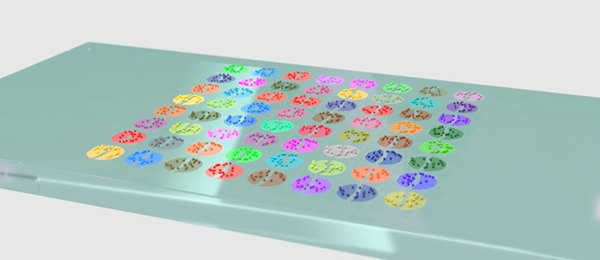
The chip: 64 molograms on one waveguide
The illustrated chip has a tantalum pentoxide (Ta2O5) waveguide, an input grating coupler, and an 8×8 array of 64 molograms. The waveguide also carries physical reference holograms engraved into it. Their equivalent mass is known, so the reader uses them to locate the array on the camera image, to align the chip, and as a signal reference. Chips come in families with different layouts, and flow chambers with one, three or four channels let several samples run over different parts of the array at once. The illustrated chip uses a single flow chamber. In the illustrated single-chamber arrangement, one injection passes over the array and the molograms are read in parallel. Shared delivery does not make all local surface conditions identical. Each mologram is named by its row and column, for example SM_R3C4. See the sensor-chip configurations.
A low-fouling surface
The copolymer coating reduces non-specific adsorption and helps preserve ligand access. Low fouling and affinity matching are separate goals. Low overall adsorption does not prove equal adsorption on ridges and grooves. Preferential adsorption on either region can produce a coherent contribution.
Ridges and grooves: completing the modulation
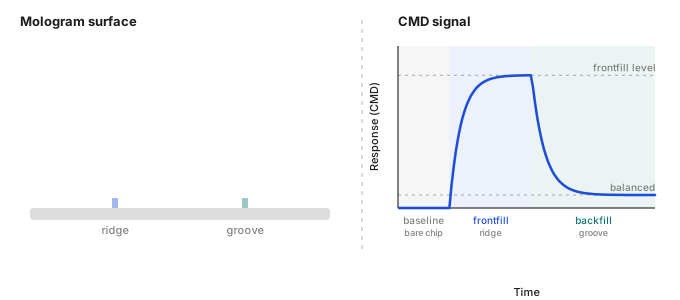
Active capture chemistry sits on the ridges; a matched, non-binding chemistry sits in the grooves. The point of the groove chemistry is not to be inert in some absolute sense. It is to make the non-specific behavior of ridge and groove the same. When they match, non-specific binding lands equally on both, carries no component at the grating frequency, and contributes no ideal coherent modulation. Target binding preferentially adds mass on the ridges. Imperfectly matched non-specific adsorption can also break the symmetry and imitate that response.
Backfilling
Groove passivation can help match the two regions. Here, “backfilling” describes the general surface-chemistry concept, not a current product preparation step. The active ligand is immobilized on the ridges first. A non-binding molecule then fills the grooves to make adsorption behavior similar in both regions. Verify that match with the relevant blank matrix; completing the procedure does not prove that the surface is matched. Reichmuth 2021.
Five surface properties with different jobs
- Low fouling
- Reduces unwanted adsorption across the surface. It helps preserve access to ligands and reduces background accumulation.
- Ligand activity
- Determines whether immobilized ligands can still recognize the target. Ligand mass alone does not demonstrate activity.
- Ligand density
- Sets potential binding capacity. Excessive density can increase crowding, transport limitation, or rebinding.
- Affinity matching
- Makes non-specific adsorption similar on ridges and grooves. It reduces patterned interference without removing the intended target contrast.
- Analyte efficiency
- Describes how effectively the bound analyte distribution contributes to coherent mass. It is distinct from the fraction of active ligands.
A larger signal is not sufficient evidence of a better surface. Compare blank response, binding capacity, reproducibility, and kinetic behavior.
When the match is imperfect
If the sample sticks a little more to the ridge chemistry than the groove chemistry, that difference is modulated at the grating frequency. It then adds to the coherent signal as a false contribution. The ideal coherent contribution depends on the ridge-groove difference. Total adsorption can still affect ligand access and scattering background. The lab below makes that explicit.
Set how much non-specific material lands on the ridges and on the grooves. In this ideal balanced model, the ridge-groove difference determines the coherent contribution. Match them, high or low, and the false signal vanishes; leave a gap and it appears.
The recipes are in the product documentation.
Adapters, oligo versus click chips, conjugation, ligand density, regeneration, and chip quality control are operational choices. They are covered by the MACS® Matchmaker documentation and the training. This page covers only why the surface is built to keep non-specific binding out of the coherent signal.
Predict before revealing the explanation. Does low adsorption on a blank prove that ridges and grooves are matched?
Reveal the explanation
No. Low fouling and equal adsorption are separate properties. Even a small difference can produce a patterned contribution; use a relevant matrix blank.