
Chips
Two chip types hold the ligand in two ways. Click-chemistry chips bind it covalently; DDI chips bind it by DNA hybridization, so the chip can be stripped and loaded again. Each type comes with a PEG groove for buffer or a matched groove for serum, plasma and lysate.
Two chip types
The name of a chip gives the chemistry on the ridges and in the grooves of each mologram: [ridge|groove]. The ridges capture the ligand. The grooves either stay inert (PEG) or take a matched control molecule, so that sample proteins land equally on both and cancel. Why that works: the surface.
Standard chips carry 64 molograms in an 8 × 8 grid. The 1-plex chips, both click chips and the QC chip are also sold in a 6 × 9 layout with 54 molograms.
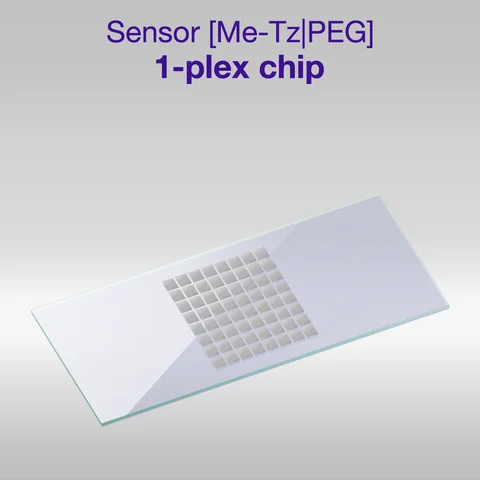
Click-chemistry chips
Methyltetrazine on the ridges couples a TCO-tagged ligand covalently.
- Stable, covalent attachment
- Suited when there is little ligand
- One ligand per chip; it cannot be released
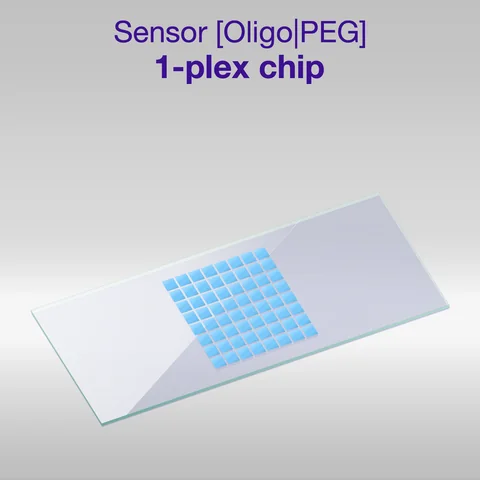
DDI chips
Single-stranded DNA on the ridges captures a ligand that carries the complementary strand.
- Strip and reload with a new ligand
- Up to 64 ligands per chip by multiplexing
- Ready adapters and panels
Click-chemistry chips
How it works. The ridges carry methyltetrazine (Me-Tz). The ligand carries a trans-cyclooctene (TCO) group, which reacts with the tetrazine and forms a covalent bond. The reaction is bioorthogonal: it does not involve the other groups of a protein.
- Inject the TCO-tagged ligand at 10 µM or more. Below that, the ligand density is usually too low.
- Cap the remaining tetrazine with 100 µM TCO-PEG4-OH for 5 min. Free tetrazine can otherwise take up analyte later and cause drift.
- Flush with at least 1 mL of running buffer to remove ligand that is only adsorbed.
What it means for a run. The ligand stays on the chip, so one chip carries one ligand. To use the chip for several cycles, regenerate only the analyte; that condition depends on the pair and has to be scouted.
[Me-Tz|PEG]
For buffer. Inert PEG grooves keep the background low.
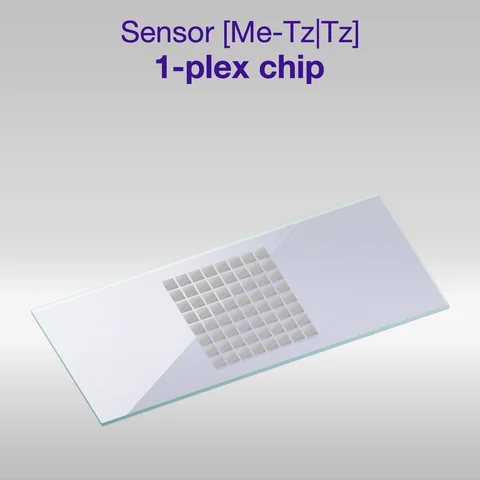
[Me-Tz|Tz]
For serum, plasma and lysate. Tetrazine grooves take a matched control molecule (backfilling).
DDI chips
How it works. DNA-directed immobilization (DDI): the ridges carry 20-mer single-stranded oligonucleotides. The ligand is conjugated to the complementary strand, with a MACSLink kit or an oligo adapter, and hybridizes only where its sequence matches.
- Inject the ligand-DNA conjugate at 200 nM. At 50 nM the density can be too low.
- On [Oligo|Oligo] chips, load the control molecule on strand 00 in the grooves (backfilling) to the same level.
- Flush with at least 1 mL of running buffer.
What it means for a run. Dehybridizing removes the ligand, usually without a regeneration condition for each new target. The same chip then takes a new ligand. Before a precious sample, check the chip with the QC Oligo (below).
[Oligo|PEG]
For buffer: oligo ridges, inert PEG grooves.
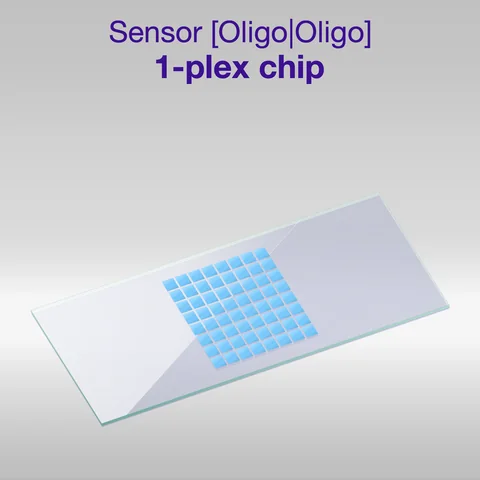
[Oligo|Oligo]
For serum, plasma and lysate: oligo on ridges and grooves, grooves backfilled.
Left: four neighboring molograms in a side view, each with its own capture sequence (01 to 04). Right: the whole chip from above, in the colors of the chip images. Inject a pooled set of ligand-DNA conjugates and watch each one find its address. Then strip the chip and inject again. Not to scale: diffusion is sped up and drawn with a pull toward the surface.
Which chip for which sample
| Buffer, purified proteins | Serum, plasma, lysate | |
|---|---|---|
| DDI: strip and reload | [Oligo|PEG] | [Oligo|Oligo], backfilled |
| Click chemistry: ligand stays | [Me-Tz|PEG] | [Me-Tz|Tz], backfilled |
Multiplexing
Multiplexing is available only on DDI chips. All 64 molograms stay active; the chip format sets how many oligo addresses share them. Each address has its own sequence, so a ligand goes only to the molograms that carry its complement. A 1-plex chip gives 64 replicates per ligand, a 32-plex chip 2, a 64-plex chip 1.
- Keep at least 2 molograms per ligand. A 32-plex chip is the usual choice.
- A reference ligand needs its own address. Sequence 00 is reserved for backfilling.
- Load all ligands to a similar density, so that their responses compare.
- Use a stable attachment. A ligand that comes off a dissociable adapter, such as His-tag on trisNTA, can bind again at a neighboring address.
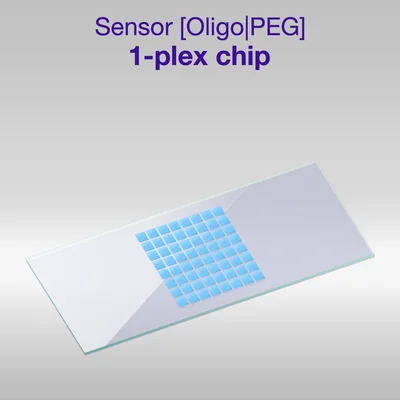
1-plex
64× per ligand
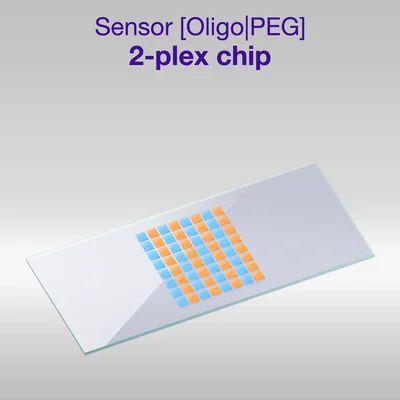
2-plex
32× per ligand
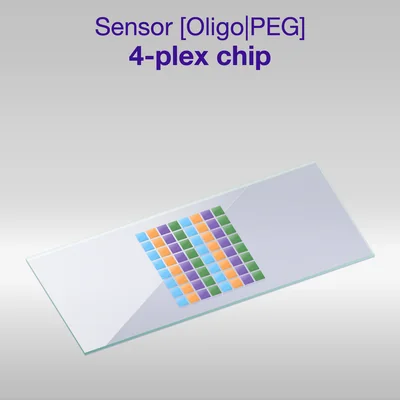
4-plex
16× per ligand
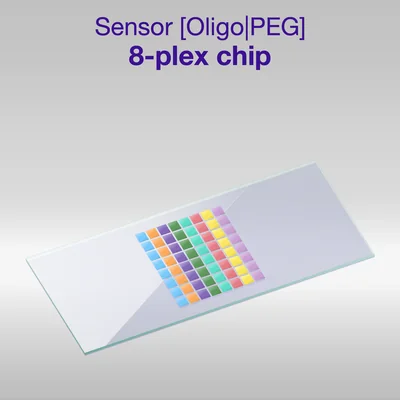
8-plex
8× per ligand
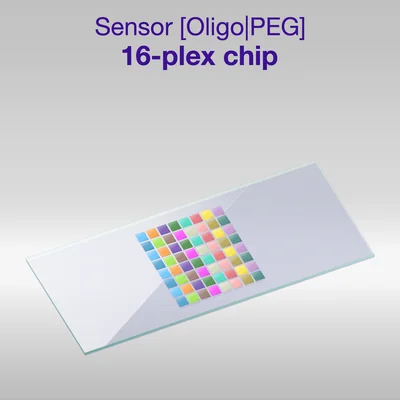
16-plex
4× per ligand
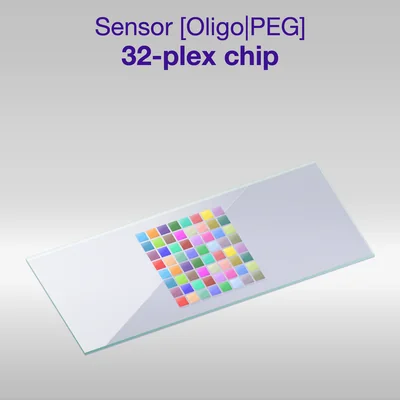
32-plex
2× per ligand
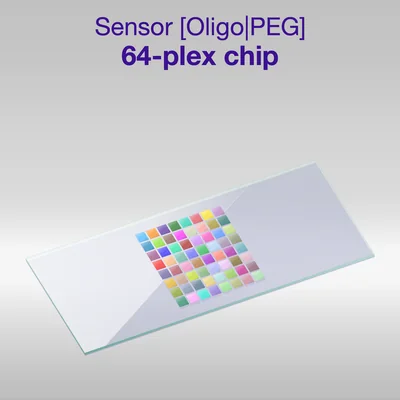
64-plex
1× per ligand · on request
Shown for [Oligo|PEG]; [Oligo|Oligo] comes in the same formats. The colors mark oligo addresses.
Store, check, block
Store chips dry at 4 °C or room temperature, never frozen or wet; shelf life is 12 months. Before a precious sample, check a DDI chip with the QC Oligo: CMD should rise toward the reference response on its Certificate of Analysis. The QC Oligo comes as a ready solution or lyophilized (10 nmol, Seq ID 00 to 16). For a check of the system itself, the [Oligo BF|PEG] QC chip carries sequence 00 on every ridge.
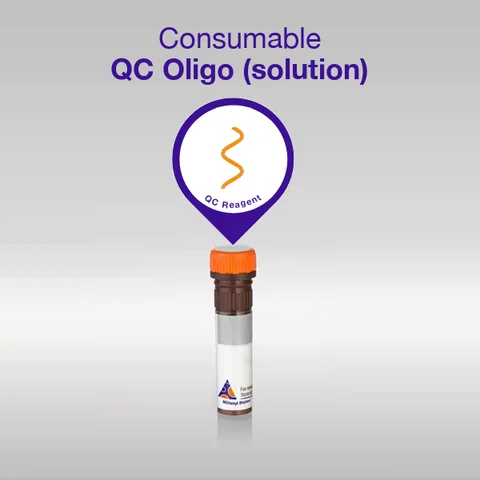
QC Oligo
The complementary strand for the chip check. Five 100 µL checks per vial; −20 °C.
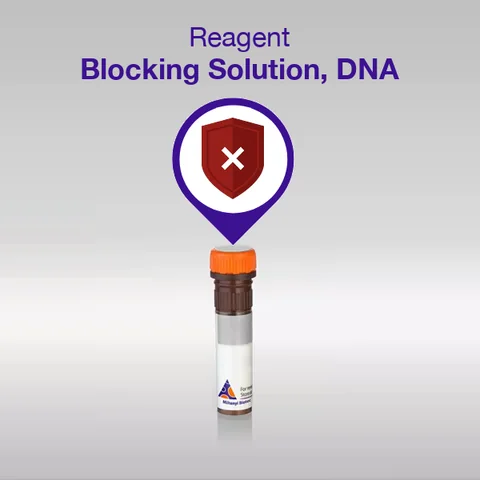
MACS Matchmaker Blocking Solution, DNA
Suppresses sample binding to oligo surfaces. 10× stock (10 mg/mL) in 0.5, 1 or 5 mL. Heat 5 min at 100 °C, spin, dilute 1:10 into the sample; −20 °C.
Choose the chamber before the chip
A seal with 3 flow paths presses on the rows between them, and those rows may not work afterwards. To use all 64 molograms, start the chip in a chamber with 1 flow path.